
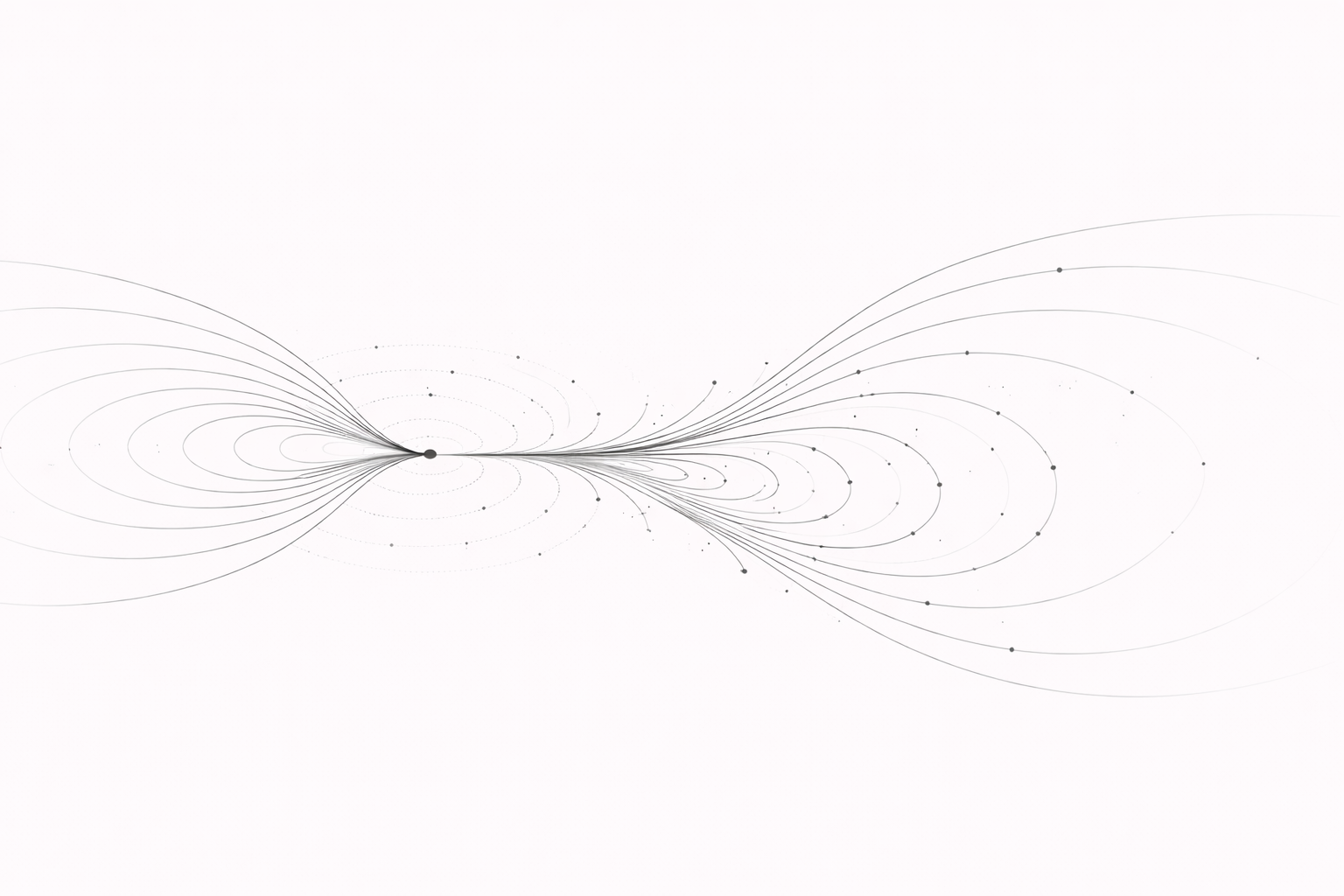
Deviation grows.
Structure reorganizes.
CHAPTER NINE
Minimal separation grows and does not reverse
Instability
Minimal separation exists between nearby positions.
Separation does not remain fixed.
Distance between nearby positions increases.
Return to prior proximity does not occur.
Nothing persists under growing separation.
Bodies occupy nearby positions.
A minimal separation exists between positions.
If no separation exists, no divergence appears.
Separation exists at the start.
Trajectories extend from these positions.
If trajectories begin identical, no divergence occurs.
Trajectories extend through space.
Each trajectory follows a different path.
If paths do not differ, separation does not grow.
Distance between trajectories increases.
Positions along each path cease to coincide.
If distance does not increase, divergence does not persist.
Coincidence between positions is lost.
Paths no longer intersect at the same points.
If coincidence remains, instability does not occur.
Return to initial proximity fails.
If alignment returns, divergence does not persist.
Separation spreads across regions.
Distance extends beyond initial difference.
If spread does not occur, instability does not persist.
Structure does not recover prior arrangement.
Relations between positions do not re-form.
If relations re-form, instability does not persist.
If separation grows, positions do not remain close.
If positions do not remain close, paths do not coincide.
If paths do not coincide, no relation persists.
Without relation, no structure remains.
Minimal separation grows.
It does not reverse.